“I was only happy once; that was at Hyères;”
Robert Louis Stevenson: Letter to Sidney Colvin, March 19, 1891
Growing up, I felt a strong urge to change places, in the hope that this would increase my overall happiness. What I longed for was a “Tapetenwechsel,” a wallpaper change, as we call a change of scenery in German. Leaving my hometown, so I believed, would rid me of the stale air and stuffiness that surrounded me, hampering not only my physical and intellectual development, but also my love for life and my luck in love.
With my wanderlust I had a natural opponent in my dad, who was convinced that real-life travel was for dummies while more civilized exemplars of our species used books instead of planes or trains to transport themselves to worlds more colorful than the grey, post-coalmining town in the glorious FR of G that he, just like me, had been born into.
Accordingly, bookshelves upon bookshelves plastered the walls of our home, blocking my view of the wood-chip wallpaper, leaving hardly any blank spots on the map for my childish mind to explore, and certainly no money in the family coffers to afford a real-life “wallpaper change”.
To manifest his position, my father cited great minds like Immanuel Kant, who never left his native Königsberg in the province of East Prussia, and who had nevertheless been able to spark a Copernican Revolution of the mind, causing a world that he had never even seen with his own eyes to henceforth revolve around his ideas.
To my dad’s advantage, there were two things I didn’t know at the time: For one, even to him, his extended journeys into the world of books did not suffice; he regularly extended his horizon by dint of certain drug-induced trips, just like the better part of his generation. For another, had I ever wanted to beat my dad in the battle of the minds, I could’ve cited as my allies a whole army of great men and women of letters.
The history of the human mind is full of stories about writers and intellectuals relocating, whether in search of inspiration and adventure, in the hope of improving their physical or mental health, or simply to escape persecution. Had they stayed in one place like good old Immanuel, most of them would have left the face of the earth even before producing their masterpiece, suffocated, hanged, guillotined, or simply withered away from weariness of life. As a result, some of my dad’s favorite pieces would’ve never seen the light of day.
Oh yes, all this could have been a strong argument in my favor. And, hey, here’s another one: More often than not, the writers’ travelogues and letters written on the road read like captivating adventure tales, gothic horror novels, or lost-love dramas. What follows is a case in point. Take this, dad!
In the fall of 1882, the Scottish author Robert Louis Stevenson was ordered south. This was what the doctor called for. Of ill health since youth – weak lungs, coughs culminating in hemorrhages – Stevenson repeatedly cheated death in the course of his short lifetime. He had almost died on a recent cross-country trip through America from New York to California. Thank goodness, some ranchers in Monterey pampered him back to health. He finally returned to the UK together with his newly-wedded wife Fanny, and plenty of inspiration for his adventure novel Treasure Island. Ring, a huge gain straight into the register of world literature!
While the novel got published as a series in a children’s magazine Young Folks and soon brought its author some fame, Stevenson’s health deteriorated again, making relocation to more southern climates appear advisable. Fanny seems to have been even worse off; her frail health forced her to stay behind while her husband embarked on his cure trip to the Med in 1882.
Had Stevenson disregarded his doctor’s counsel and stayed in the UK, he might have never gotten to write “The Strange Case of Doctor Jekyll and Mister Hyde” (published 1886) – a gothic horror novella that explores the split personality but common identity of an honorable doctor and a murderous criminal. The text was one of my dad’s favorites, and I will never forget how he read it to us with alternating voices when we were little, despite that some of RLS’ output was not exactly suitable for young folks this time around.
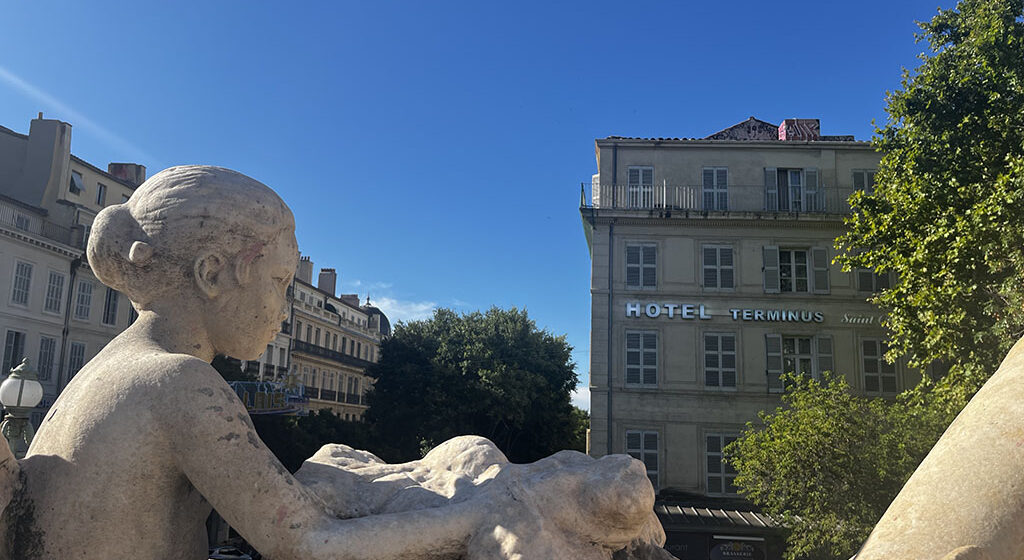
Stevenson’s 1882 search for climate conditions more suitable to his frail constitution – you guessed it – brought him to the south of France. He started his journey in Montpellier and travelled eastward. In Marseille, he checked in at a hotel called Terminus (!), right by the monumental train station Saint Charles. Here, Fanny finally joined him, and the two soon found a house for rent in the suburb Saint Marcel, about 10 km east of the Old Port.
At the start, the couple believes that they have discovered paradise on earth. The house is spacious, has several rooms, commands over a generous plot of land including an olive garden cultivated by a “resident paysan.” The property is well-connected with state-of-the-art public transportation by two horse-driven omnibus lines as well as the nearby Saint Marcel train station. In his letters, Stevenson praises the surrounding landscape and the view from the house as an Eden of overgrown mountains and valleys, “better than any Alps”.
But the troubled couple’s bliss is transient, to say the least. Stevenson’s penchant for morbid wordplay proves more fatal than a self-fulfilling prophecy. Their beautiful country house has the name Campagne Defli, well-sounding, yet bare of any clear meaning, which is enough to provoke the writer’s poetic license. In his letters, he lets himself get carried away by a free play on words, linking Campagne Defli with a “campagne demosquito” that he says he has launched against the armadas of mosquitoes pestering him and Fanny in Marseille. After a visit to the house to take inventory, he expresses the suspicion that the place may be infested with flees and announces that he was looking forward to applying lots of insecticides in his “campagne deflee”.
Alas, reality soon proves more dire than the author’s poetic imagination; and the climate conditions in Saint Marcel more harmful to human health than his insecticide campaign to bugs. No doubt, the shifting Marseille climate doesn’t bring the hoped-for healing effects. The couple’s health problems persist, and a reader of their letters might gain the impression that the couple started a competition about who of the two’s condition be more worrisome.
First, it is Fanny who is bedridden, forcing her husband to stay by her side and not even leave the property. Soon after, it is Louis again whose health declines and whose repeated hemorrhages from the lungs cause Fanny to worry he might not survive their winter in Saint Marcel. To make matters worse, a bad fever epidemic, “typhus, I believe,” breaks out in the village. Fanny decides to send her Louis to nearby Nice by train as soon as his condition allows, hoping that a change of climate will be beneficial to his health; her limited means do not allow her to accompany him.
Meanwhile, people die like flies in Saint Marcel. When the disease carries off the aforementioned ‘resident paysan,’ his corpse ends up lying by the gate of Campagne Defli, with his stomach obscenely bloated, blocking exit from the property. Fanny herself has to drag the dead body aside to make sure that her husband, weakened by illness, would not see it on his way to the station.
While his stint in Nice seems to have had a calming effect on the husband’s health, the separation put a strain on the couple’s relationship. When Fanny waits in vain for a telegram from her husband, she decides to travel to Nice herself, concerned that Louis may have either passed away or, now that he has regained his strength, eloped with a pretty Frenchwoman (yes, Fanny was scarred by infidelity from her previous marriage). Thankfully, she finds her Louis alive in his hotel bed, with no sign of a mistress. The climate in Nice seems to have restored his health at least partially. However, misfortune is not about to leave the two of them alone.
On her train ride back to Marseille, Fanny is molested by an Englishman who seems to have chosen her husband as his nemesis, and discrediting him as his pick-up strategy. In a letter to her mother-in-law, Fanny writes:
“He insisted on stopping his journey a day to help me in my affairs. Here is a specimen of the horrid person’s talk: ‘What are you going to do when your husband dies?’ ‘I don’t expect him to die.’ ‘Oh, I know all about that. I’ve heard that kind of talk before. He’s done for, and in this country they’ll shovel him underground in twenty-four hours, almost before the breath is out of his body. His mother’ll never see him again.’ I do not speak but look intently out of the window. Again he speaks, leaning forward to be sure that I hear him. ‘Have him embalmed; that’s the thing; have you got money enough?’ Can you fancy five hours of this? I got out in the rain several times to try to get into another carriage, but they were all filled.”1
After this episode, Fanny realizes that she cannot stay in Marseille, especially not by herself. The search for happiness on earth thus continues – until they find a house named “Châlet La Solitude” – well-sounding, again, but a dash more promising – in a town called Hyères, on the French Riviera between Marseille and Nice.
Like Marseille, Hyères’ history started as a Greek colony, founded by the same people who came here from Asia Minor. Its Greek name was Olbia, which means the happy one. It’s no surprise that it’s here where RLS finally finds his happy place. As he’d later write in a letter to his friend, the literature and art critic Sidney Colvin, his time in Hyères was the only period in his life when he was truly happy.2 What exactly did this happiness consist of? And what does it have to do with the special location and nature of the place? Or could we find an explanation in the name of the “Châlet La Solitude”? Answering these questions might be stuff for another episode.
Call me superstitious, but since my youth, I’ve had an inkling that personal happiness is intricately linked to the place you reside in. Having lived in 4 countries, 6 cities, in over 16 neighborhoods, and in about 20 different apartments, my initial hunch has been proven wrong by lived experience at least as many times. And yet, I move on.
When I first moved to Marseille three years ago, no doctor had told me to do so. Unlike Stevenson, the reasons for my move weren’t related to ill-health. But there was certainly a feeling of ill-fit that pushed me out of grey and grumpy Berlin, further south, into sunnier terrain. Have I found my happy place? Come ask me today, and I may reply with a wholehearted: Yes! Ask me again tomorrow, and I might say: Hell no, please get me out of here as soon as possible!
Marseille is a mercurial kind of beast. Living here is a Doctor Jekyll and Mister Hyde experience. Even more so than in other cities, life around here shifts from bliss to bestiality in the blink of an eye. On good days, it’s like being in paradise: ten minutes to the sea on the horseback of a public bicycle; the sky is blue, the Mediterranean blows fresh air into your neck and the sweet perfume of fig trees and fresh soap into your nose. But this bliss is transient. It’s often just a breath later that you inhale scooter fumes, vapors of rancid urine, or the putrid smell of dead rats.
Sure, these may just be the nuisances of a functioning, even if rotting, urban biotope. They would scare away a bourgeois kiddo from the French capital, but certainly not a working-class descendant of a coalminers’ dynasty like me.
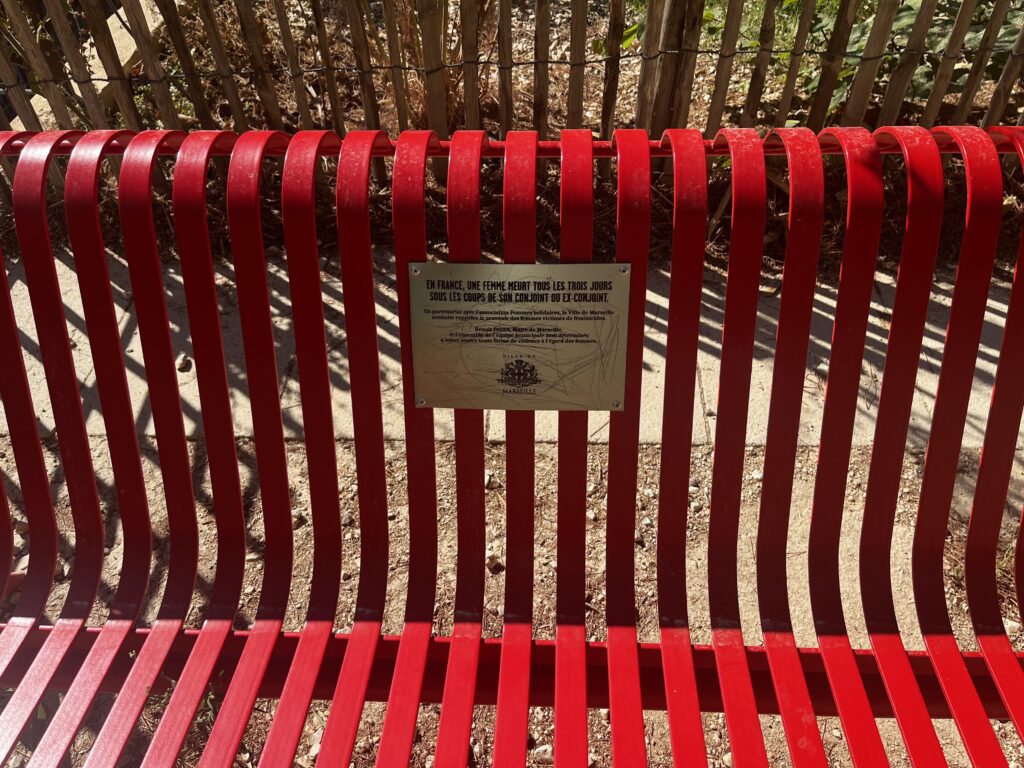
When the rotten rats are covered up by burning piles of trash though (pent-up anger against systemic police violence must eventually find some outlet), you get reminded that the rot around here runs deeper than any rodent would ever dig. When you come to sit on a park bench with a plaque that counts how many women die per day at the hands of their partners – you realize that Mister Hyde might be hiding just behind the next street corner. Oh yes, this city is real. Can you handle it? Only one day at a time!
Our dear RLS once wrote: “Man’s one method, whether he reasons or creates, is to half-shut his eyes against the dazzle and confusion of reality.”3
Was it wise to follow this maxim when, a couple of weeks ago, a fierce wildfire broke out at the gates of Marseille? A car on a highway had caught fire. Like a spark plug, it ignited the surrounding forest that had been dried up by months of continuous drought, plus a recent heatwave. The result was a natural disaster just 20 km from our house, and only 10 km away from the Marseille airport, in the commune Les Penne Mirabeau, a northern suburb of Marseille. The commune’s Latin motto is “super pennas ventorum” meaning “on the wings of the wind” – and winging it did: the notorious regional wind Mistral picked up to speeds of 70 km/h, not only fanning the flames, but also carrying a black-and-brown cloud of smoke straight into the city.
In no time, Marseille’s usually white daylight was tinted in all shades of red, purple, and pink. Instead of precipitating longed-for drops of rain, the cloud sprayed ash into our street and onto our balcony. The authorities shut down the airport, reduced train traffic at the station to a bare minimum, and I closed all windows and shutters like they told me to. And yet, our living room started smelling like a smoke stack, and the air that we inhaled seemed to contain as many molecules of carbon as of oxygen. Continued exposure – a health risk? Perhaps. An unpleasant experience? You bet! When our neighborhood cheese shop on Rue Paradis closed its doors due to “a toxic cloud,” we embarked on an overnight stint to nearby Hyères. Time for a Tapetenwechsel and some fresh air.

Rising temperatures coupled with increasingly irregular rhythms of drought and rainfalls increase the likelihood of wildfires of this sort. Most of us are slow to understand that this is, at least partly, the result of our own doing. And instead of changing our ways, we half-shut our eyes against the dazzle and confusion of this increasingly unpleasant reality.
True or not, Stevenson’s maxim certainly helped him to create great works of fiction. But is it as suitable to reason, make sense of, and live a continued happy life in the real world? I’m not so sure.
To close, and at the same time settle the feud with my late father, I want to give pause for thought: between my dad’s and my own way of life lies a third option. You neither have to bunker yourself in between walls of bookshelves; nor do you have to always peruse far-off horizons to get away from unpleasant or unhealthy realities at home. Instead of a “wallpaper change”, you may want to try and change the interior and exterior architecture of your home or hometown.
Sure, improving mores, airs, or miasmas of your place of dwelling doesn’t always seem a viable option. But if more of us decided to commit to such projects, we might stand a chance to actually change something for the better. In the end, it might not be an either-or situation, but rather a both-and operation. Go ahead and dig your nose deep into your books for inspiration and cautionary tales. Then take your favorite reading on a trip and see how the folks on the other side of the border manage to grow the grass so green and lush. But please, while on the road, take notes and bring them back from your trip. They’ll help you figure out what can be done better back home. In times where health is increasingly turning into an environmental concern (again), you might be well-advised to go on a little cure trip every once in a while. Hope you’ll come back stronger, well prepared to take on the urgent changes that you guys need back home.
- Nellie van de Grift Sanchez: The life of Mrs. Robert Louis Stevenson. London: Chatto & Windus,1920, p. 103. ↩︎
- Sidney Colvin (ed.): The Letters of Robert Louis Stevenson. New York: Charles Scribner’s Sons, 1911, p. 288. ↩︎
- Robert Louis Stevenson: “A Humble Remonstrance,” Essays by Robert Louis Stevenson, New York, Chicago: C. Scribner’s Sons: 1918, p. 257-8. ↩︎